
It’s September, and for many retailers the focus is now on getting stores, refurbishments and upgrades ready ahead of the critical end-of-year Christmas trading period.
This edition of The Retail Read looks at what’s driving retail spending and business confidence heading into the critical Christmas trading period, and what the latest building approvals data means for developers and retailers with projects in the pipeline. We also break down how digital ordering is reshaping store formats at major QSR chains, and round up the key regulatory changes under Green Star Buildings v1.1 and the new Green Star Fitouts standard.
Retail Trade & Spending
Traditionally a quiet period in retail, it’s no surprise that retailers such as JB HI-FI have seen same-store sales falling in the months of July and August.
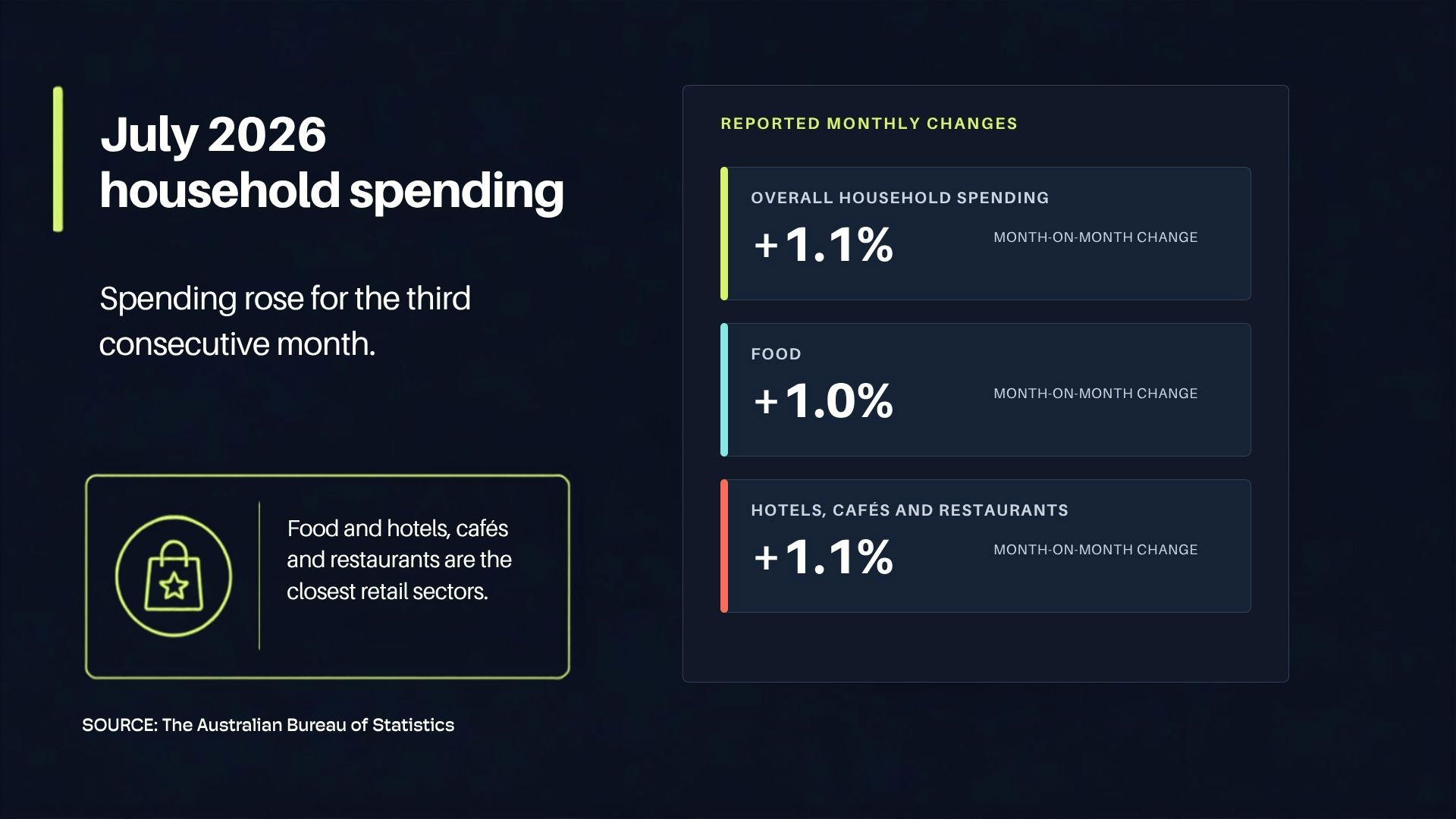
As JB Hi-Fi’s chief executive Nick Wells says, “Customers are looking to spend in those key promotional periods”. And that’s exactly what most retailers will be hoping for. With Black Friday sales and the key Christmas period approaching, we will soon see whether the 1.1% overall increase to household spending will flow into other retail sectors like it has for hotels, cafés and restaurants (1.1% increase) and groceries (1.0%).
There’s a lot of noise around the fact that business confidence is down in Victoria. According to the August 2026 NAB Business Survey, however, this is a trend being felt across Australia, with confidence falling for a second straight month to -8 index points and business conditions turning negative for the first time in six years, as rising costs continue to squeeze margins.
Put side-by-side, these data points show a clear pattern emerging. Household spending hasn’t stalled, in fact it’s now increased for three months running and shifted toward convenience and dining out. People are being deliberate with their spending, choosing options they resonate with. More often than not, that comes down to how a space makes them feel the moment they walk in, whether it’s quick and easy to move through, or worth lingering in for that coffee. As competition for this everyday spend heats up, it’s the businesses that get that experience right who’ll turn a passing visit into a habit.
Stock Levels Pipeline
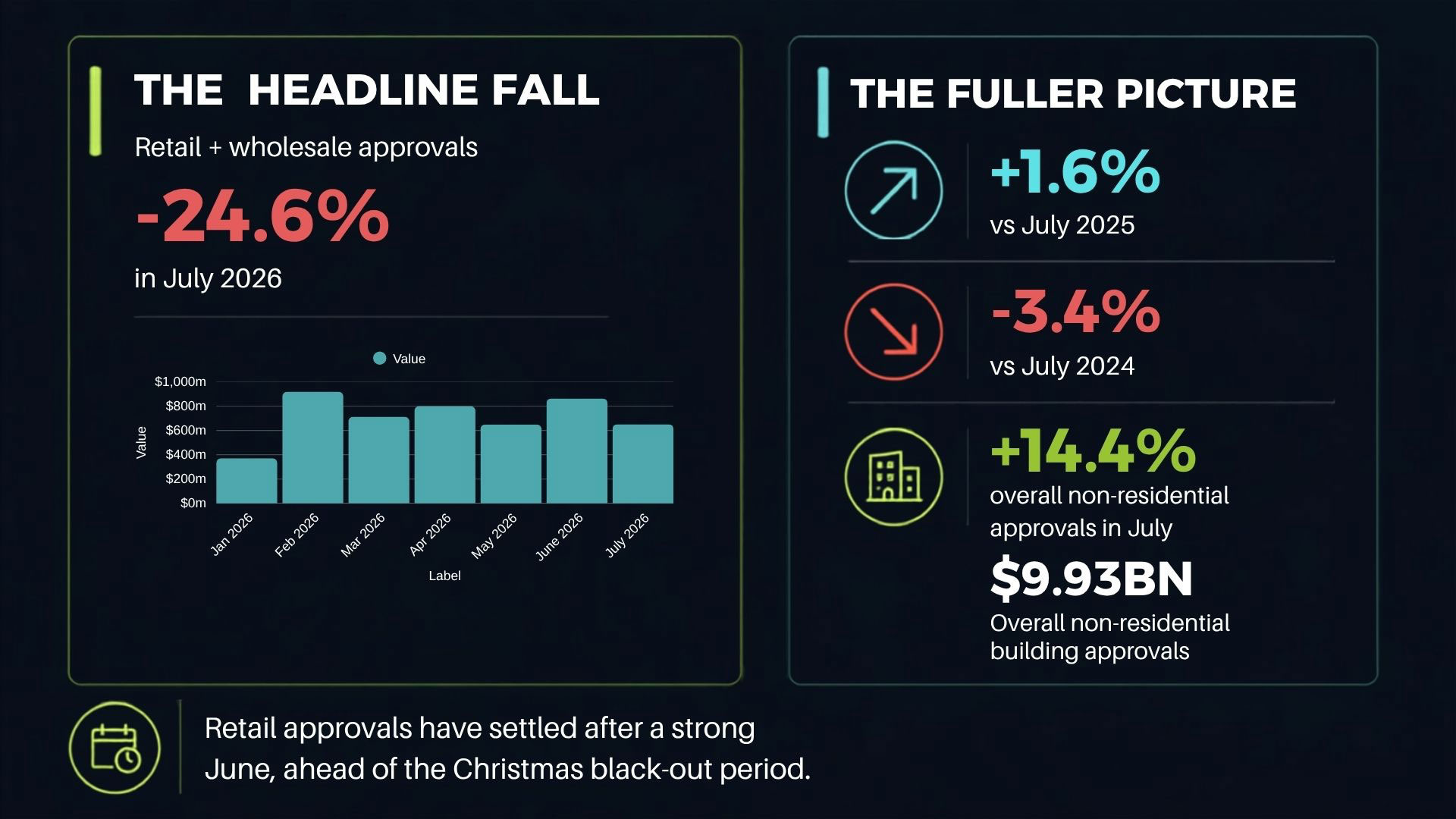
Retail and wholesale trade building approvals fell 24.6% in July 2026, down to $651.1 million after a strong June. On its own, that’s a headline-grabbing fall.
However the reality, as always, is a lot more nuanced. That $651.1 million is actually 1.6% higher than the same month last year, and only 3.4% below where approvals sat two years ago in July 2024.
After a strong June, it’s no surprise that Retail approvals have settled, particularly as we edge closer to the Christmas black-out period. It’s also important to note that overall, non-residential building approvals were up 14.4% in July, to $9.93 billion, showing a solid appetite for commercial work.
We can see now that retail construction is steady, and according to the August 2026 NAB Business Survey, Construction Conditions are up 9 points. Together painting a picture of significant opportunity for developers and retailers to capitalise on builder availability.
Format & Design Trends
Digital ordering is taking over and naturally, format follows customer behaviour.
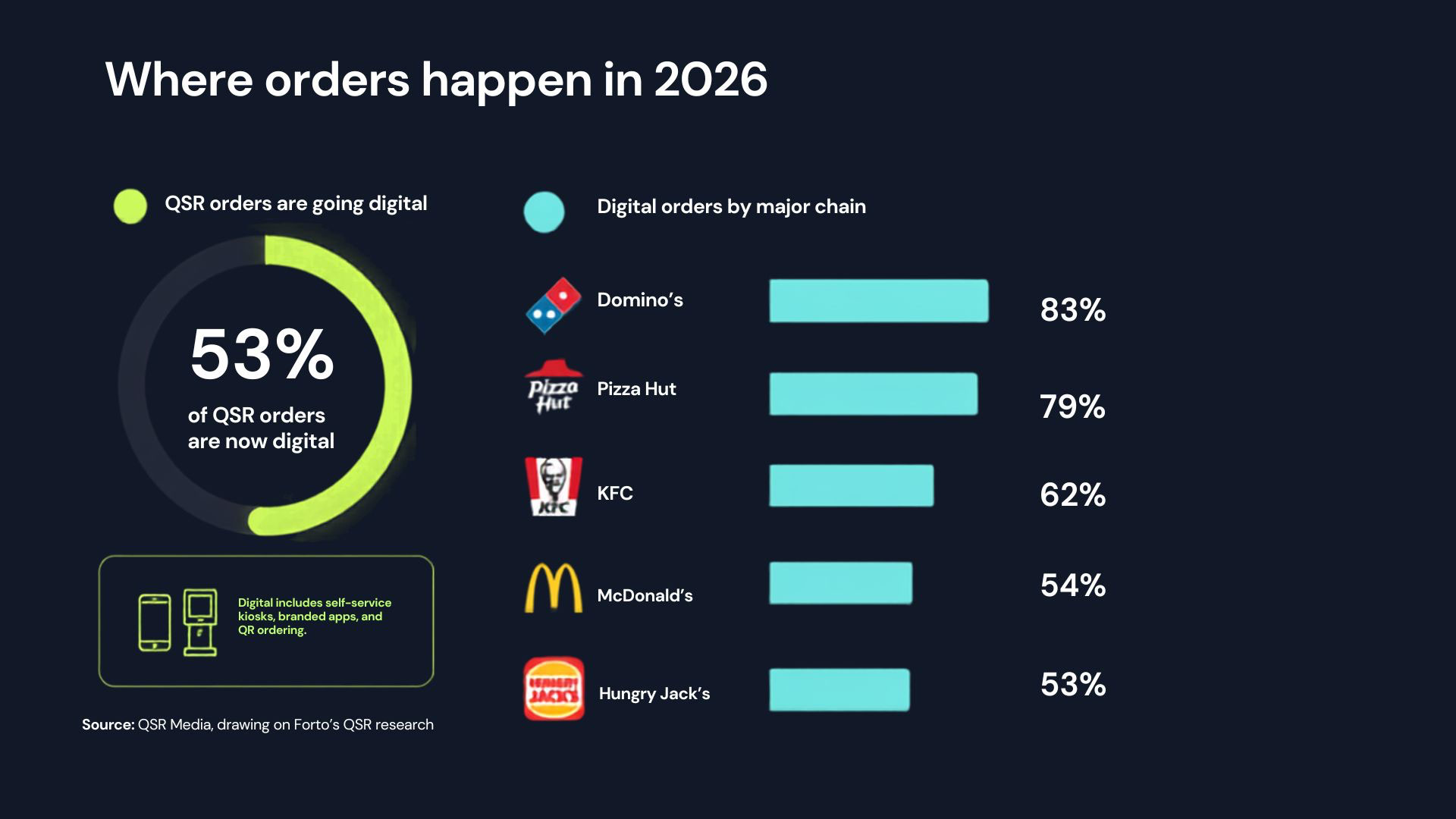
Recent Australian data reported by QSR Media, drawing on Fonto’s QSR research, found that 53% of QSR orders are now digital.
This includes self-service kiosks, branded apps and QR ordering.
At major chains, the figures reported were:
– KFC – 62% digital
– McDonald’s – 54% digital
– Hungry Jack’s – 53% digital
– Domino’s – 83% digital
– Pizza Hut – 79% digital
As a result we are seeing physical stores becoming smaller with less investment into dining spaces and more into drive-thru, pick up zones, parking, back-of-house operations and technology integration including: kiosks, digital menu boards, order-status screens, apps, AI ordering and integrated POS systems.
Regulatory & Compliance
Green Star Buildings v1.1 launched in October 2025, and as of 1 May 2026 all new Green Star Buildings projects must register under v1.1. Projects already registered under v1 can continue under that version.
Green Star Buildings v1.1 makes all-electric buildings the baseline and strengthens requirements around materials and refrigerants. This is particularly relevant for supermarkets and food retail where refrigeration systems can have a significant carbon impact.
The launch of Green Star Fitouts in 2026 brings circularity into sharp focus. A mindset that encompasses the full life-cycle of a retail space, reuse, responsible material selection, lower-carbon construction, adaptability and disassembly are all imperative considerations.